
Ten Frames: The Simplest Tool for Kindergarten Number Sense
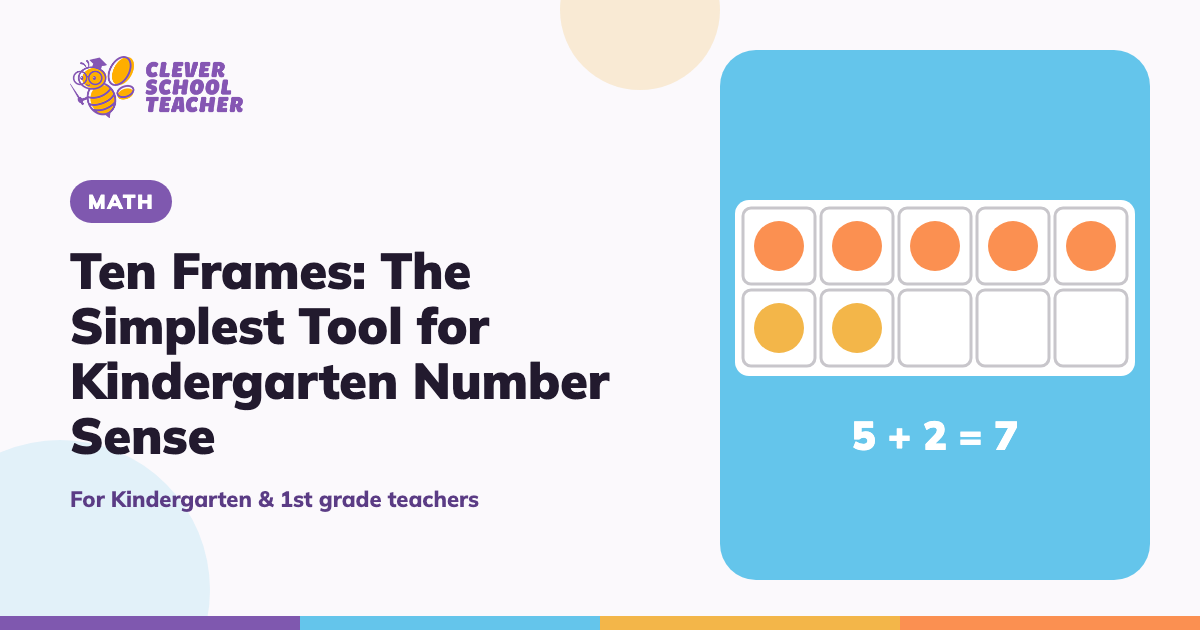
If you could keep only one math tool in your kindergarten classroom, a strong case could be made for the humble ten frame. Two rows of five boxes. That is it. Yet this simple grid helps children see numbers, compare them, break them apart and, eventually, add and subtract with real understanding.
Here is why ten frames work so well, how to introduce them, and a set of quick routines you can use all year in kindergarten and 1st grade.
Why Ten Frames Build Number Sense
Number sense is a child's feel for what numbers mean: how big they are, how they relate to each other and how they can be put together and taken apart. Counting is part of it, but number sense goes further. A child with strong number sense knows that 8 is close to 10, that 6 is one more than 5, and that 7 can be made from 5 and 2.
Ten frames support all of that because they organize quantities around two important anchors: 5 and 10. When children see a ten frame with the top row full and three more on the bottom, they do not need to count each dot. They can see "five and three more," which is 8, and also "two empty spaces," so 8 is two away from 10. That kind of structured seeing is the foundation for mental math later on.
From counting to subitizing
Subitizing is recognizing how many are in a small group at a glance, without counting. Most young children can subitize small amounts, like 2 or 3, quite naturally. Ten frames help children extend that to larger amounts by combining groups they know. This is sometimes called conceptual subitizing: seeing 7 as a full row of 5 plus 2.
Introduce the Ten Frame Slowly
Start with a five frame, a single row of five boxes, especially early in kindergarten. Once children are comfortable filling it, showing amounts and noticing how many empty spaces are left, move to the full ten frame.
Teach one convention clearly: fill the top row first, from left to right, then the bottom row from left to right. Having a shared way of filling the frame means that every 6 looks the same, which is exactly what lets children recognize amounts quickly. Later, you can explore other arrangements on purpose (what does 6 look like as 3 on top and 3 on the bottom?), but start consistent.
Use real objects first. Mini erasers, counters, buttons or seasonal manipulatives in a large ten frame mat keep things concrete. Then move to dot cards and printed frames, and finally to quick mental images.
Ten Frame Routines for Kindergarten
Quick looks
Flash a ten frame card for two or three seconds, then hide it. Ask, "How many did you see? How did you see it?" Children might say, "I saw five on top and one more," or "I saw two empty boxes, so it's eight." These short, five-minute discussions are powerful because children hear several ways to see the same number.
Build it, show it
Call out a number and have children build it on their own ten frame mats. Then ask a follow-up question: "How many more to make ten?" or "Is that more than five or less than five?"
One more, one less
Show a number on the frame. Add one counter: "What is one more?" Take one away: "What is one less?" Because the frame is structured, children can see the change instead of recounting from 1.
Ten frame match-up
Mix ten frame cards, numeral cards and number word cards, and have children match them. This works well as a center once the routine has been modeled.
Ten Frame Routines for 1st Grade
Make ten
Combinations that make ten are a key 1st grade skill. Show 7 on a ten frame and ask, "How many more do we need to make ten?" Children see the 3 empty boxes. Pair this with number bonds or equations (7 + 3 = 10) so children connect the picture to the symbols.
Double ten frames for teen numbers
Two ten frames side by side show teen numbers as "ten and some more." A full frame plus 4 is 14: one ten and four ones. This is an early, visual step into place value.
The make-a-ten strategy
For facts like 8 + 5, show 8 on one frame and 5 on another. Move 2 counters to fill the first frame. Now it is 10 + 3, which is 13. Children do the moving physically at first, then learn to picture it. This strategy is far more flexible than memorizing facts in isolation, and it leads naturally to mental addition with larger numbers.
Subtraction as "take from ten"
For 13 - 5, show 13 on double ten frames, then take 3 from the ones and 2 more from the full ten. Children can see there are 8 left. Seeing both operations on the same tool helps children understand how addition and subtraction are related.
Keep It Short and Frequent
You do not need long ten frame lessons. Five to ten minutes a day, as a warm-up or at the start of your math block, will do more than one long lesson each week. Short, frequent practice keeps the images fresh and lets you watch who is counting every dot and who has started to see groups.
That watching is useful information. A child who counts each dot one by one needs more work with fives and quick looks. A child who instantly says "eight, because two are missing" is ready for make-ten and double ten frame work.
Try This Tomorrow
- Make a set of ten frame cards for 0 to 10 (or print a set) and flash three of them during your warm-up.
- After each card, ask, "How did you see it?" and record two or three ways on the board.
- Give each child a ten frame mat and ten counters. Call out numbers and ask "how many more to make ten?"
- In 1st grade, try one make-a-ten problem, like 9 + 4, with counters.
- Jot down which children are still counting every dot so you can pull them into a small group.
Resources to Keep Ten Frames in Play
Back to School Numbers 0-10 and Kindergarten Number Sense include ten frame practice alongside tally marks, number words and counting. For fall, Pumpkin Patch Counting 1-20 moves from counting sets to 10 to building teen numbers on ten frames. Looking for more hands-on ideas? Our earlier post on five and ten frame activities has plenty. You can find more under counting and number sense in the library, and a free trial lets you download what you need for this week.