
Teaching Sight Words the Heart-Word Way
For years, many of us taught sight words the same way: a stack of flashcards, a word wall and lots of "just remember it." Some children soaked the words right up. Others could say "the" on Monday and stare blankly at it on Tuesday. If that sounds familiar, the heart-word approach may be the change your word work needs.
Heart words give children a way to understand high-frequency words instead of memorizing them as shapes. It is simple, it fits right alongside systematic phonics, and it takes just a few minutes a day.
First, a Quick Vocabulary Check
High-frequency words are the words that show up most often in text: the, and, is, was, said, you, of and so on. Many of them are perfectly decodable (and, in, it, can). Some have one or two parts that do not follow the patterns children have learned yet (said, was, the, of).
Sight words are any words a reader recognizes instantly, without sounding out. The goal is for every word, eventually, to become a sight word. The question is how children get there.
Research on how children learn to read words points to a process often called orthographic mapping: readers connect the sounds in a spoken word to the letters that spell them, and that connection is what makes a word stick in long-term memory. Memorizing a word's overall shape does not create that connection. Linking its sounds to its letters does.
What Makes a Word a "Heart Word"
With the heart-word approach, you look at a high-frequency word with children and ask two questions: Which parts can we sound out with what we know? Which part is tricky, the part we have to learn "by heart"? Children mark the tricky part with a small heart.
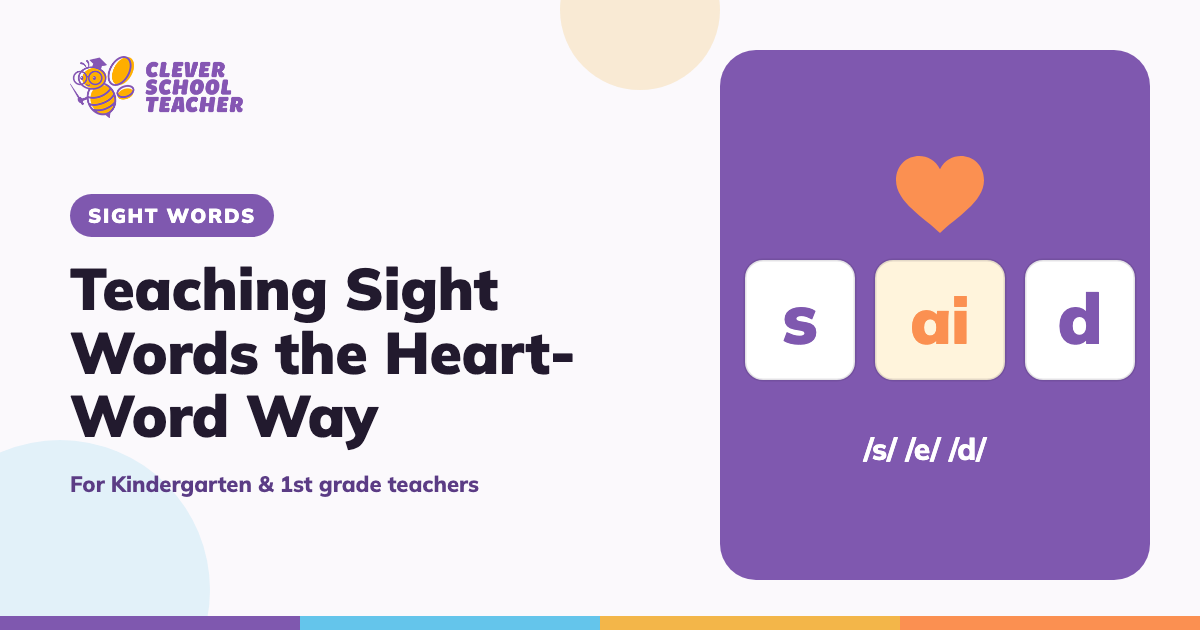
Take the word said. It has three sounds: /s/ /e/ /d/. The s and the d do exactly what children expect. Only the middle is tricky, because ai is spelling the /e/ sound. So children put a heart over ai. Now instead of memorizing four random letters, they are remembering one unexpected spelling.
A few more examples:
- the: /th/ /u/. The th is regular once taught. The e saying /u/ gets a heart.
- was: /w/ /u/ /z/. The w is regular. The a saying /u/ and the s saying /z/ both get hearts.
- of: /u/ /v/. Both letters are unexpected, so the whole word gets a heart.
- you: /y/ /oo/. The y is regular; the ou gets a heart.
Some hearts are temporary
A word like like is fully decodable once children learn silent-e (vowel-consonant-e) patterns. In kindergarten, though, they need it long before that lesson comes. Many teachers call these temporary heart words or "flash words." Teach the tricky part as a heart for now, and when you get to that pattern later, celebrate: "Remember like? Now we know why it works!" Children love taking the heart away.
A Five-Minute Heart-Word Routine
Use the same steps for every new word. Two new words a week is plenty for most kindergarten classes; first graders can often handle a few more.
1. Say it and use it
Say the word and use it in a sentence. Have children repeat the word. "Said. My friend said hello. Say said."
2. Count the sounds
Children tap or push a counter up for each sound they hear: /s/ /e/ /d/, three sounds. Use sound boxes (a strip of three connected squares) so they can see each sound's place.
3. Map the letters
Write the letters for each sound in the boxes. Note that one sound can take more than one letter; in said, the middle box holds ai.
4. Find the heart
Ask, "Which part did we expect? Which part is tricky?" Draw a heart above the tricky spelling.
5. Write it and read it
Children write the word while saying each sound, then read it in a sentence or short passage. Writing matters. Saying sounds while forming letters strengthens the sound-letter connection much more than looking alone.
Keep the Words Alive After the Lesson
A single lesson will not make a word automatic. Children need repeated, spaced exposures in different formats. Try these:
- Heart-word wall: post words with their hearts visible so children can refer back to the tricky part.
- Quick daily review: flash the week's words for one minute during morning meeting or before lunch.
- Build it: have children build words with letter tiles, saying each sound as they place it.
- Read it in context: decodable sentences and mini-books that combine heart words with the phonics patterns you have taught.
- Games: partner games like memory or "I have, who has" give lots of reps without the drill feeling.
What About Old Word Lists?
You do not need to throw out your Dolch or Fry lists. They are useful for choosing which high-frequency words to teach. Just change how you teach them. Group decodable words with the phonics lesson they match (teach and right after short a and the letters n and d) and save heart-word lessons for the ones with tricky parts.
It is also worth retiring a couple of older habits. Word-shape boxes (drawing around a word's outline) and guessing a word from its first letter and a picture both pull attention away from the letters, which is exactly where we want it.
Try This Tomorrow
- Pick two high-frequency words from this week's text.
- Draw three or four sound boxes on your whiteboard for each one.
- Run the five-step routine: say it, count the sounds, map the letters, find the heart, write and read.
- Add the words to your wall with the hearts showing.
- Give each child a decodable sentence that uses one of the words.
Resources to Practice Heart Words
Seasonal practice keeps review fresh. Fall Sight Word Mini-Books put high-frequency words into short, readable books, and Sight Word Flip Books give children a hands-on way to review. You will find many more options under sight words in the library, and our older post on high-frequency word games for small groups has plenty of review game ideas. If you would like to print them for your class, you can start a free trial and see how it fits your week.