
CVC Words That Actually Work: A Step-by-Step Blending Routine
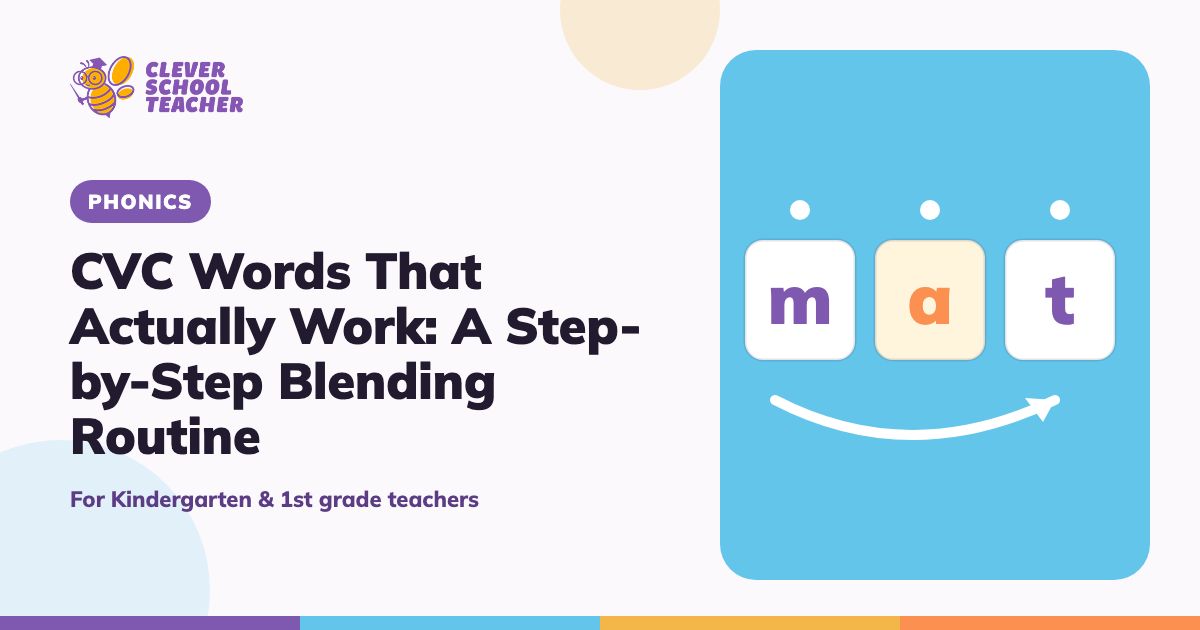
There is a moment every K-1 teacher waits for: a child looks at m-a-t, says the sounds, and then their face lights up as they say "mat!" That moment does not happen by accident. Blending sounds into words is a skill that has to be taught directly, practiced often and built up in small steps.
This post walks through a simple, repeatable blending routine for CVC (consonant-vowel-consonant) words that you can use in whole group or small group, plus the word lists, common sticking points and quick fixes that make it work.
What Blending Really Requires
Before children can blend printed words, they need a few building blocks in place:
- Phonemic awareness: the ability to hear and join individual sounds orally. If a child cannot blend /m/ /a/ /t/ when you say the sounds out loud, the printed version will be much harder.
- Letter-sound knowledge: quick, automatic recall of the sounds for the letters in the word. A child who has to pause and think about what a says will lose the first sound before reaching the last.
- Left-to-right tracking: looking at letters in order and holding them in memory.
This is why explicit, systematic phonics works so well for beginning readers. Letters and sounds are taught in a planned sequence, and children read words made only of the sounds they already know. When they meet a word, they can actually decode it instead of guessing from a picture.
Start With Oral Blending
Spend a few minutes each day blending with no print at all. Say the sounds of a word slowly and have children say the word: "/s/ /u/ /n/... sun!" Start with two sounds (/a/ /t/), then move to three. A robot voice or a "sound slide" down your arm makes it fun and visual. These quick warm-ups build the ear for blending that children will need when they face print.
Choose Words Wisely
Not all CVC words are equally easy. You can make early blending much more successful with a few smart choices.
Begin with continuous sounds
Continuous sounds are sounds you can stretch without distorting them: /m/, /s/, /f/, /l/, /r/, /n/ and all the vowels. Words that start with a continuous sound, like mat, sun, fan and lip, let children hold the first sound and slide right into the vowel ("mmmaaat").
Stop sounds such as /b/, /d/, /g/, /k/, /p/ and /t/ cannot be stretched. When you say them, keep them short and crisp. Say /b/, not "buh." That extra "uh" is one of the most common reasons children blend bat into "buh-at."
Use only taught letters
If you have taught m, s, a, t, p and i, that is already enough for sat, mat, map, tap, pit, sit, tip and pat. Build your word lists from your scope and sequence, not from a random list online.
One short vowel at a time, then mix
Many programs start with short a, add short i, and then begin mixing the two. Mixing is important. If every word in the lesson has a, children can stop looking at the vowel altogether.
The Step-by-Step Blending Routine
Use the same steps every time so children can focus on the thinking instead of the directions. Each word takes under a minute once children know the routine.
Step 1: Point and say each sound
Write the word or build it with letter cards. Point under the first letter; children say the sound. Move to the next letter; children say that sound. Continue to the end.
Step 2: Blend
There are two common approaches, and you can use either:
- Continuous blending: children stretch the sounds together without stopping, sweeping a finger under the word: "mmmaaat."
- Cumulative (successive) blending: children say the first sound, then the first two together, then add the last: "/m/... /ma/... /mat/." This helps children who lose track of the first sound by the time they get to the last.
Step 3: Say it fast
Sweep your finger quickly under the whole word and have children say it at normal speed: "mat!"
Step 4: Check the meaning
Ask a quick question or use it in a sentence: "The cat sat on the mat." This connects decoding to meaning and helps children catch themselves when they blend a nonsense word by mistake.
Step 5: Read it again
After a set of five or six words, go back through them faster. Repeated reading of the same words builds the automaticity that leads to fluent reading.
Level Up With Word Chains
Once children can blend single words, word chains are one of the most effective next steps. Change one letter at a time and have children read each new word: sat to mat to map to mop to top. Because only one sound changes, children have to attend to every position in the word, including the tricky middle vowel.
Flip it around for spelling. Say "Change mat to map," and have children swap a letter tile. Encoding (spelling) and decoding reinforce each other, so do both every day.
Common Sticking Points and Quick Fixes
- Adding "uh" to stop sounds: model crisp sounds and have children put a hand under their chin; "buh" drops the jaw more than a clean /b/.
- Saying sounds but not blending: go back to oral blending with two sounds, then use cumulative blending in print.
- Guessing from the first letter: cover the picture, use word chains and praise looking all the way through the word.
- Mixing up vowels: give a vowel reference card with a keyword picture for each short vowel, and practice the vowel sounds in isolation daily.
Move Quickly Into Connected Text
Blending lists is not the goal. Reading is. As soon as children can blend a handful of words, put decodable sentences and simple decodable books in their hands. A sentence like "Sam sat on a mat" feels like real reading to a five-year-old, and it is. Keep a couple of high-frequency words in the mix too (see our post on teaching sight words the heart-word way).
Try This Tomorrow
- Spend two minutes on oral blending before your phonics lesson: five words, three sounds each.
- Write six CVC words using only letters your class knows, starting with continuous sounds.
- Teach the five-step routine exactly the same way for every word.
- Finish with a five-word chain, like sit, sip, sap, map, mop.
- Have each child read one decodable sentence to you during centers.
Ready-to-Use Blending Practice
If you want printables that follow this routine, Short Vowel Word Work: Short a & Short i gives 1st graders sorts, a word chain and decodable passages for those first two vowels, CVC Segment and Blend gives children lots of hands-on practice, and Pumpkin Patch CVC Word Families brings decodable -at, -ig, -og and -un words into a fall theme. You can browse all of our phonics resources in the library, and if you would like to download them, a free trial is the easiest way to start.